

By Peri Dworatzek
IEFLL Partnership Coordinator
PhD Student at York University
March 2026
As the Chief of Economic and Environment Statistics at United Nations-Economic and Social Commission for Western Asia (UN-ESCWA), Wafa Aboul Hosn, has been leading the establishment of environmental statistical reporting according to global statistical standards for decades. At the UN-ESCWA Wafa leads research that coordinates the production of economic and environmental official statistics with Arab countries. This includes tracking data trends about water and energy in relation to national economies, and inline with the System of National Accounts (SNA) and the System of Environmental and Economic Accounting (SEEA). This often includes technical assistance and mobilizing funds since countries might be interested in tracking this empirical evidence but lack resources to develop yearly environmental accounts. Although, it often takes years for countries to produce this data, it ends up being very beneficial for them to track resource depletion and hold certain entities accountable for extraction activities. More recently, Wafa has been a part of the UN campaign to move beyond Gross-Domestic Product (GDP). Recognizing the flaws of GDP in measuring wellbeing, the UN is preparing a new system of national accounts that connects nature to the economy and tracks sustainability.
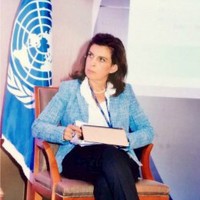
Wafa completed a Ph.D. at McGill University, in Montreal, Canada, in applied statistics and environmental science. Her research focused on studying fish growth and fishing patterns, which led to important research contributions that connected ecology and biodiversity to statistical methods. During the PhD, she provided expertise to the UN office based in Montreal and that eventually led her to apply for a position at the UN-ESCWA.
Wafa is also a partner of the International Ecological Footprint Learning Lab (IEFLL) representing the UN-ESCWA and a committee member of the Science Advisory Committee for the Footprint Data Foundation. Wafa is an expert in the UN data sources such as FAO and Comtrade, which are used heavily in the National Ecological Footprint and Biocapacity Accounts (NEFBA). As an international partnership, Wafa believes IEFLL has an important opportunity to connect scientific communities. Specifically, there is a need to connect practitioners and scholarly communities, to share research and data between both sides. Additionally, Wafa believes the IEFLL partnership has an opportunity to link footprint metrics to the movement going beyond GDP. Since ecological footprint and biocapacity measure impacts on the environment in relation to economic systems and the NEFBA are already produced on a yearly basis.
As a member of the Science Advisory Committee, Wafa believes a key research area to improve the NEFBA is to incorporate satellite imagery and Earth Observation data. Although, FAO is very reliable data, the most up-to-date data sources come from satellite imagery. Another research area that Wafa believes is important for the longevity of the NEFBA is to improve the relevance of the global hectares unit. Global hectares is the unit that measures ecological footprint and biocapacity; it’s a relative metric that allows for comparability and scalability of the data. Yet it’s not a standardized metric around the world and sometimes this confuses researchers. Wafa believes the unit has a lot of value as a weighted average to show the relative impact humans have on the environment across different ecosystems. But footprint researchers can do a better job at arguing it’s relevance across scientific communities.
Wafa nears the end of her career at the UN-ESCWA, as she is moving onto early retirement. One of the key lessons she has learned is the importance of connecting people across borders, disciplines, and sectors. On the path to provide a sustainable life for future generations, it’s important to share research, raise awareness, and collaborate across differences.
Leave a Reply
You must be logged in to post a comment.