

By Deborah King
Masters Student at York University
January 2026
Introduction
Healthy ecosystems are intricate networks that sustain life, regulate climate, and recycle waste (World Health Organization, 2025; Miller et al., 2021). When humanity’s demand surpasses the regenerative limits of these systems, we move beyond the boundaries of sustainability into a state of imbalance known as overshoot (Miller et al., 2021; Franz & Papyrakis, 2010). Humanity has exceeded the planet’s biocapacity limits since 1970 (Miller et al., 2021), contributing to food insecurity, “biodiversity loss, and accelerated climate change” (Franz & Papyrakis, p2, 2010).
In response, interest in tools that assess humanity’s impacts and guide more sustainable decision-making has grown. Among these, ecological footprint has emerged as one of the most holistic measures, by aggregating the impacts of consumption, production, and global trade into a single unit of biologically productive land, expressed in global hectares (Franz & Papyrakis, 2010). Recognizing ecological footprint’s ability to translate complex ecological data into understandable terms, many organizations began creating personal ecological footprint calculators to help individuals understand their own impacts (Collins et al., 2017; Franz & Papyrakis, 2010). Building on this momentum, the team at ClimateHero developed a climate calculator to raise awareness and create “actionable reduction pathways” (J. Heurlin, Head of B2C and co-founder, ClimateHero, personal communication, October 27, 2025; ClimateHero, n.d.), a gap they noticed with most existing calculators.
Building ClimateHero
Environmentalists at heart, Swedish duo Anna and Robert Sabelström founded Climate Hero AB in 2018, after recognizing how significantly individual lifestyle choices contribute to global emissions. They originally launched ClimateHero’s Climate Footprint Calculator for the Swedish market, “with the ambition to scale internationally”.
What immediately stands out about ClimateHero’s platform is its modern and streamlined interface. The site is refreshingly free of distracting adware or pop-ups, creating a professional and trustworthy interface. It sets user expectations on the homepage, stating that the quiz takes about 5 minutes to complete and is divided into three distinct sections: Housing, Travel, and Consumption.
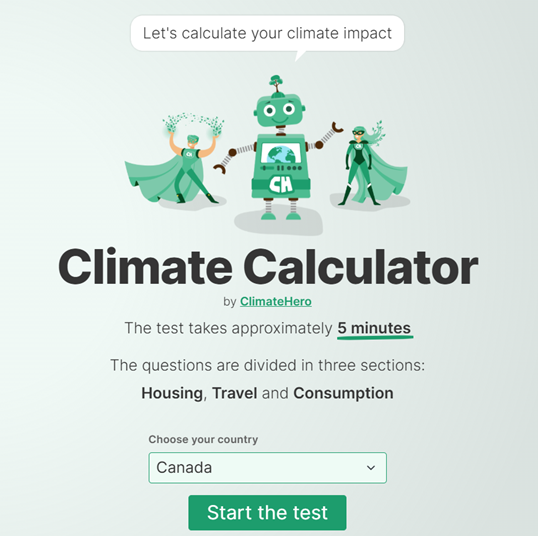
The calculator delivers on its promise, taking just under six minutes to complete. Each section includes roughly fifteen questions, with some variation depending on earlier responses. For instance, when asked how many cars a household owns, follow-up questions prompt users to provide details about each vehicle’s engine type, kilometers driven per year, year of manufacture, and size. Despite this level of detail, none of the questions felt overly technical or difficult to answer. Even when addressing energy consumption, the phrasing remained accessible. For example, they question how many hours one uses air conditioning during warmer months, instead of requesting specific kilowatt-hour data.
The interface itself is clean, responsive, and intuitive. Users can easily go back to revise answers or revisit earlier sections if needed. The scrolling format of the interface created a sense of movement and progress, making the experience feel modern and engaging. Overall, the design and flow of the questionnaire strongly reflect the founders’ intent to make the application “quick, simple, and fun”.
Calculator Comparison
For comparison, the UK World Wildlife Fund for Nature (WWF-UK) Environmental Footprint Calculator, one of the more frequently cited in literature (Franz & Papyrakis, 2010; Collins et al., 2017), offers a useful point of reference in evaluating ClimateHero’s design and scope. WWF’s questionnaire is divided into four categories (Food, Travel, Home, and Stuff) containing roughly six questions each (WWF-UK, n.d.). However, the survey appears to be designed primarily for a UK audience. Prices are presented in pounds, and several questions reference UK-specific terms, such as green tariffs. Travel-related questions also assume the user’s point of departure is within the UK, distinguishing between domestic (UK/Ireland), mid-haul (to/from Europe), and long-haul (to/from outside Europe) flights (WWF-UK, n.d.).
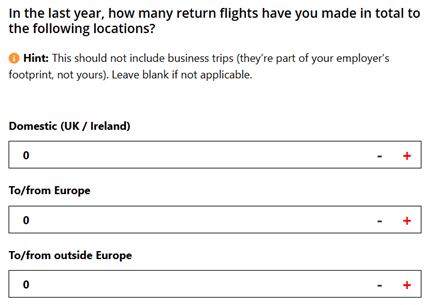
Another shortcoming is that WWF’s calculator focuses exclusively on new product consumption, without addressing how users manage old or unwanted items. It doesn’t ask whether goods purchased are second-hand or recycled.
In contrast, ClimateHero’s Climate Footprint Calculator captures all of WWF’s categories but introduces a greater level of behavioral nuance. For instance, instead of simply asking how much one spends on clothing each month, ClimateHero explores how people consume. It probes shopping frequency, whether users prioritize quality or price, engagement with second-hand purchasing, and what happens to items once no longer needed.
Communicating Impact
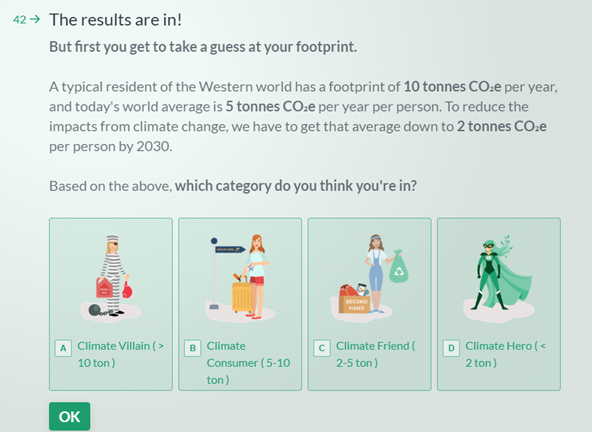
Where ClimateHero really shines is in the way it delivers results. Rather than feeling like the end of a difficult test, the experience is interactive and playful, inviting users to guess how they scored.
Furthermore, unlike many calculators that solely emphasize shortcomings, ClimateHero allows users to explore what they’re already doing well before presenting actionable suggestions for improvement. This approach helps avoid a sense of judgment, which Franz & Papyrakis (2010) note is often associated with environmental tools, as they can inadvertently criticize users for “good” behaviors.
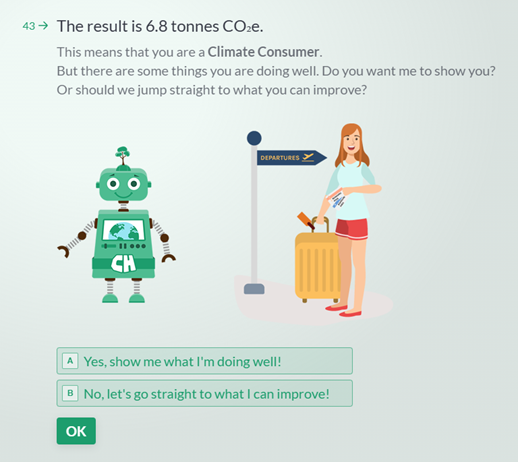
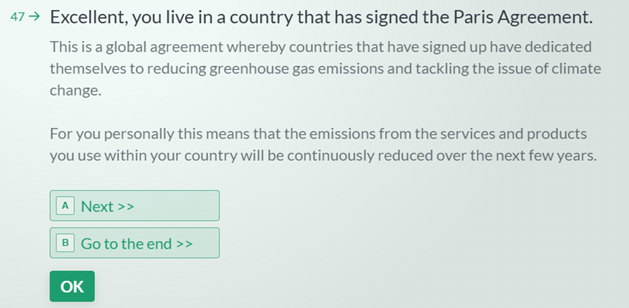
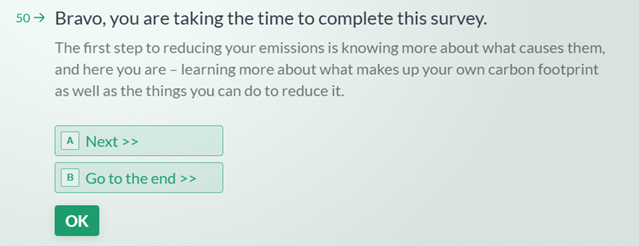
Two noteworthy aspects in the delivery of my results were the tool’s connection to policy, acknowledging Canada’s commitment to the Paris agreement, and recognition that simply completing the survey represents a step in the right direction.
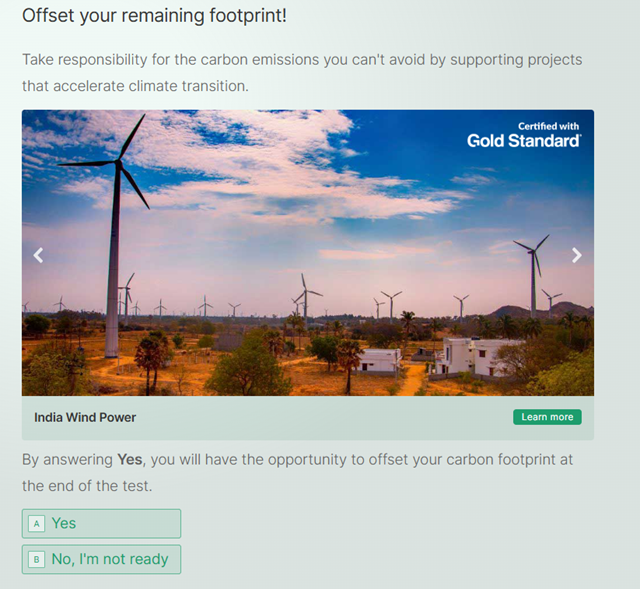
Exploring areas where it could improve was also a surprisingly positive experience. ClimateHero incorporates commitment-based scoring, allowing users to immediately see how specific behavior changes could reduce their overall impact. For example, choosing to eat more vegetarian meals could reduce my climate impact by 0.2 tonnes of CO2e per year. After making as many commitments as feasible, users are then given the option to offset their remaining footprint through the certified Gold Standard. This integration of reducing and offsetting sets ClimateHero apart, as Franz & Papyrakis (2010) note that most calculators rarely provide guidance beyond the results to facilitate sustainable progress.
Scope
A major limitation of ClimateHero’s calculator is its exclusive focus on carbon emissions (CO2e). While carbon accounts for the largest share of global Ecological Footprint, at approximately 62% in 2024 (Lo et al., 2025), it represents only one dimension of humanity’s ecological demand. This is particularly evident in high-income countries such as Canada and the United Kingdom, where carbon has dominated national footprints respectively at 57% and 58% in 2024 (Lo et al., 2025). However, a substantial share of ecological pressure still comes from cropland, grazing land, fishing grounds, built-up area, forest products, and forest carbon uptake (Miller et al., 2021).
EF goes beyond tracking emissions by measuring humanity’s total demand on regenerative systems (Miller et al., 2021). This more holistic methodology enables connections between consumption and the capacity of ecosystems to renew resources and metabolize waste (Miller et al., 2021). It also creates a shift in perspective from lowering emissions to critically thinking about how to live within the planet’s biological limits (Miller et al., 2021).
ClimateHero’s focus aligns with dominant net-zero frameworks, but these frameworks often risk oversimplifying the challenge. Achieving net-zero requires navigating complex land-use trade-offs, including cropland required for biofuels and plant-based materials, and built-up land for renewable energy infrastructure. Ecological footprint brings these spatial implications into view, offering a more complete understanding of what net-zero entails.
Outlook
All things considered, ClimateHero collects far more holistic lifestyle data than many existing tools, including WWF’s calculator, which presents its results in ecological footprint units, global hectares. Assuming WWF’s conversion factors accurately reflect user ecological footprint, ClimateHero could realistically evolve into a hybrid ecological footprint-climate footprint calculator with access to the appropriate coefficients and land-use conversion data. Exploring a partnership with the International Ecological Footprint Learning Lab (IEFLL) could help bridge climate and resource dimensions further, expanding both the scope and impact of ClimateHero’s already impressive work.
References
Collins, A., Galli, A., Patrizi, N., & Pulselli, F. M. (2017). Learning and Teaching Sustainability: The Contribution of Ecological Footprint Calculators. Journal of Cleaner Production, 174, 1000–1010. https://doi.org/10.1016/j.jclepro.2017.11.024
ClimateHero (n.d.). About ClimateHero. Retrieved on November 9, 2025 from https://www.climatehero.org/en/about
ClimateHero (n.d.). Climate Hero – Questions and Answers. Retrieved on October 19, 2025 from https://climatehero.me/faq-en/
ClimateHero (n.d.). Climate Calculator. Retrieved on November 9, 2025 from https://climate-calculator.climatehero.org/
Čuček, L., Klemeš, J. J., & Kravanja, Z. (2012). A Review of Footprint Analysis Tools for Monitoring Impacts on Sustainability. Journal of Cleaner Production, 34, 9–20. https://doi.org/10.1016/j.jclepro.2012.02.036
Franz, J., & Papyrakis, E. (2010). Online Calculators of Ecological Footprint: Do They Promote or Dissuade Sustainable Behaviour? Sustainable Development, 19(6), 391–401. https://doi.org/10.1002/sd.446
Lo, K., Miller, E., Dworatzek, P., Basnet, N., Silva, J., Van Berkum, J. L., Halldórsdóttir, R. B., & Dyck, M. D. R. (2025). National Ecological Footprint and Biocapacity Accounts, 2025 Edition. Data and metadata version 1.0. Produced for Footprint Data Foundation by researchers at York University and University of Iceland. https://footprint.info.yorku.ca/data/
Miller, E., Robinson, J., McMaster, M.-L., Holloway, E., & Kapoor, A. (2021). Ontario’s Ecological Footprint and Biocapacity: Measures and Trends from 2005 to 2015. Report submitted to the Ontario Ministry of Natural Resources and Forestry https://footprint.info.yorku.ca/files/2021/11/OntarioEFBreport_20211119.pdf?x92789
Wagner, C., & Gibberd, J. (2022). Reducing Students’ Ecological Footprints Through Self-Developed Interventions. South African Journal of Psychology, 52(4), 533–544. https://doi.org/10.1177/00812463221130196
WWF-UK (n.d.). How Big is Your Environmental Footprint? Retrieved on November 9, 2025 from https://footprint.wwf.org.uk/
Leave a Reply
You must be logged in to post a comment.